AI Software Development Program with AI Agents
Enterprise Software Development with AI Agents
 Application closes on
12th Nov 2026

 Speak with our expert
+16178125122




Receive Your Brochure Copy
Get details on syllabus, projects, tools, and more

Enterprise Software Development with AI Agents
Application closes 12th Nov 2026
Why should you join this program?
-

AI-Native Software Development
Learn how AI agents are reshaping software development, from writing code and modernizing legacy systems to testing, security, and enterprise workflows.
-
Built on MIT’s Legacy of Innovation
MIT is ranked #1 in the world, #1 in AI and Data Science, and #1 among U.S. national universities, reflecting its global leadership in research, innovation, and technology education. (2027 Rankings)

LEARNING OUTCOMES
What will you learn to build and apply?
Through a structured learning journey, you will build the capability to:
-
Evaluate AI models and tools based on capabilities, limitations, performance, and cost trade-offs.
-
Direct AI agents using structured specifications and system ontologies to generate code.
-
Design new systems and modernize legacy codebases using AI agents and low-risk refactoring strategies.
-
Build AI-enabled software using agentic architectures, retrieval-augmented generation (RAG), and MCP servers.
-
Verify AI-built software via automated testing, AI evaluations, and formal verification for critical systems.
-
Apply security guardrails, manage AI costs, and redesign workflows and team roles for AI-native engineering.
Receive a Certificate of Completion from MIT Professional Education
-
#1 in World Universities
QS World University Rankings, 2027
-
#1 in AI and Data Science
QS World University Rankings by Subject, 2027
-
#1 in National Universities
U.S. News & World Report Rankings, 2027


Program Highlights
Why choose the program?
-
Learn from MIT Faculty
Gain insights from live online sessions from world-renowned MIT faculty, who translate cutting-edge research into practical applications.
-
Attend Mentorship by Industry Experts
Benefit from live mentorship sessions led by AI experts across diverse industries, offering insights tailored to practical applications.
-
Work with a Comprehensive Suite of AI Tools
Gain hands-on experience with Claude Code, OpenAI, Docker, MCP, G5, and more
-
Hands-On Learning
Develop practical skills by building AI agents and AI-enabled software with industry-leading AI tools, through weekly exercises, graded projects, and a Capstone Project.
-
Learning Support
Get personalized assistance from a dedicated program support team and academic support via the Great Learning community, project discussion forums, and peer groups.
-
Globally Recognized Credential
Earn a digital certificate of completion from MIT Professional Education upon completion.


Skills you will learn
Agent design
Spec-driven development
MCP server development
Evaluation and Testing
System Extension and Design
ontology-driven design principles
Production Readiness Assessment
privacy and compliance monitoring
scalability best practices
prompt engineering
model and cost comparison
architecture decision records (ADRs)
view more
- Overview
- Learning Path
- Curriculum
- Projects
- Tools
- Certificate
- Faculty
- Mentors
- Fees
- FAQ
Who is this program for?
The program equips professionals to lead AI-native software development adoption across their organizations
-
AI, Data, and Technology Professionals
Who want to build, test, and ship software more efficiently with AI agents while adhering to organizational security requirements.
-
Solution Architects and System Architects
Who want to design systems that AI agents can build reliably, ensuring scalability, security, and maintainability at enterprise scale.
-
Technology Managers and Leaders
Who want to guide teams through AI-driven development, accelerate delivery, maintain quality and security, support team morale, and control costs.
-
Product Builders
Who want to accelerate product definition and delivery with AI agents while ensuring outcomes align with product vision and enterprise requirements.
Experience a unique learning journey
-
Learn from world-renowned faculty
Learn critical concepts through live online sessions led by MIT faculty.
-
Engage with your mentors
Clarify your doubts and gain practical skills during weekly live sessions.
-
Work on hands-on projects
Work on projects to apply the concepts & tools learned in the module.
-
Get personalized assistance
Our dedicated Program Support Team will support you through your learning journey.




Comprehensive curriculum
Designed by MIT faculty, the curriculum progresses from foundational Generative AI and Agentic AI concepts to deploying reliable enterprise software with AI agents, culminating in a Capstone Project.
Pre-Work
The pre-work establishes a consistent technical setup and foundational experience for all learners, regardless of background, so that live sessions can be dedicated entirely to core concepts.
Key takeaways:
Module 1: Foundations of AI-Native Development
This module builds a grounded understanding of the models and agents that are changing how software is built, replacing hype and guesswork with practical intuition for what they can and cannot do. Learners explore how agents reason, act, and collaborate with engineers, giving them the foundation to work alongside agents with confidence for the rest of the program.
Week 1: Course Overview and First AI App
Key takeaways:
- Understand how AI is changing software, including interfaces designed for agents
- Identify and address common pitfalls in AI-assisted coding, such as security issues and hallucinated code
- Build a working app end to end with Claude Code
Week 2: Generative AI and LLMs
- Design and execute different prompting strategies for reliable output
- Evaluate different AI models (closed-source and open-source) on a range of metrics like quality, cost, and latency
- Navigate the tooling landscape: coding assistants, agent orchestration frameworks, and evaluation and monitoring tools
Week 3: Agentic AI Fundamentals
Learn how AI agents think and act, and how to direct coding agents as a force multiplier in your daily work.
Key takeaways:
- Understand agent architectures: the agent loop, tool use, and function calling
- Build a functional AI agent that connects to external tools and systems
- Improve agent reliability by spotting failure modes and adding guardrails
Module 2: Engineering Systematically with Agents
In this module, learners move from prompt-driven development to a structured, repeatable way of working with agents: defining intent clearly, setting standards for design and security, and verifying AI-generated work against a professional bar. It develops the engineering discipline that distinguishes AI-native engineers from those who simply prompt.
Week 4: Requirements, Architecture Design and Testing with AI
Learn to build secure, maintainable AI-assisted software through clear specifications, sound architecture, and rigorous testing
Key takeaways:
- Build precise specifications from given requirements that an AI coding agent can consume to generate software
- Design with strong software engineering principles like modularity, separation of concerns and suitable design pattern
- Generate, evaluate, and maintain effective tests with AI support
- Use human review and feedback loops to improve code quality and save costs
Week 5: Quality Assurance for AI Systems with Formal Verification
Learn to produce high-quality, reliable software by applying formal verification to prove code correctness.
Key takeaways:
- Understand the foundations and purpose of formal verification
- Identify AI use cases where correctness guarantees are essential
- Define invariants and use formal tools to verify system properties
- Evaluate the benefits, limitations, and identify adoption challenges
Week 6: Refresher Break
Module 3: Organizing AI-Native Software Development in Enterprises
This module moves from individual productivity to the organization as a whole. It addresses the questions engineering leaders face in practice: how AI fits into the systems a company already runs, and how teams, processes, and accountability need to evolve around it.
Week 7: Ontology-Driven Development
Learn to capture system intent in structured form, and apply it to building new systems and modernising existing ones.
Key takeaways:
- Model system intent with ontologies and knowledge representation
- Link ontologies to correctness through formal verification
- Pick appropriate strategies for extending and refactoring brownfield systems safely
- Evaluate and choose agent, pipeline or hybrid architectures for greenfield builds
- Learn to identify high-impact use cases and apply best practices for building new AI products
Week 8: Organizational Strategy
Understand how AI reshapes engineering teams, processes, and economics, and how to lead that change.
Key takeaways:
- Understand how AI reshapes traditional SDLC workflows like Waterfall, Agile, and Kanban
- Design an AI-native software development lifecycle workflow by versioning prompts, models, data, and pipelines alongside code
- Measure the ROI and cost of AI, and make build-vs-buy decisions
- Define team guidelines, collaboration practices, and approval processes
Module 4: Building AI-Enabled Systems
The final module moves from using AI to build software to building software with AI at its core. Learners complete the program by taking a real project from idea to a production-ready result and presenting it to peers and faculty.
Week 9: Building AI Software
Learn to add intelligent capabilities to your products and make your systems ready for an agent-driven world.
Key takeaways:
- Integrate AI into brownfield and greenfield systems
- Build an MCP server that makes your system usable by agents
- Add observability with logging, tracing, and monitoring of AI behavior
- Design for reliability and scalability, and control costs in AI systems
Week 10: Security, Compliance, and Production Deployment
Learn to defend AI systems against new threats and run them reliably and compliantly in production.
Key takeaways:
- Identify and safeguard against AI-specific security vulnerabilities, like prompt injection, data leakage, and adversarial inputs
- Assess privacy, data protection, and regulatory considerations relevant to an AI system
- Understand the advantages and risks of long-running, autonomous, and self-improving agentic systems
Week 11: Refresher Break
Module 5: Capstone Project
The final module is dedicated to the Capstone Project and showcase. Learners present a complete, working AI project that integrates the skills learned throughout the program, with project work discussions, peer reviews, and presentations, where top projects are presented to the full cohort.
Week 12: Capstone Showcase
Learn how to design, build, evaluate, and secure an end-to-end agentic application for a real enterprise problem, then present it at the final-week showcase. Learners choose a direction that fits their role and industry.
- AI-Enabled Email Reader: Build a personalized email client that prioritizes messages, summarizes threads, drafts replies, extracts action items, and automates routine follow-ups.
- Custom Relationship Management System: Build a tailored CRM to manage contacts, engagements, meeting notes, follow-ups, and relationship history, with the option to add AI-generated summaries and reminders.
- Personal Knowledge Hub: Create a searchable workspace for notes, documents, links, and meeting records, with semantic search and automated organization.
- Insurance Claim Triage Agent: Build an agentic system that can read claims, classify severity, flag potential fraud, and route claims to the appropriate queue.
- IT Helpdesk Portal: Create a ticketing system with issue categorization, knowledge-base articles, status tracking, and optional AI-assisted troubleshooting.
- Personal Finance Assistant: Build a private financial dashboard that consolidates spending, budgets, and bills, and provides AI-assisted explanations of spending patterns and budget recommendations.
Self-Paced Module: Claude-Based AI Workflows
This module is designed to build practical capability in applying Generative AI and Agentic AI using the Claude ecosystem in real-world contexts. Participants build the ability to design, execute, and evaluate AI-driven workflows for real-world applications, supported by structured learning. *Disclaimer: Access to tools within the Claude ecosystem is not included as part of the program. Participants may choose to explore advanced capabilities independently.
Design and Execute AI Workflows
Build and Deploy AI Systems at Scale
Note: The curriculum listed above is indicative and subject to updates as technology evolves.
What projects will you work on?
Engage in hands-on projects and a capstone using Claude Code, OpenAI, Python, and leading AI tools.

Customer Operations
Support Ticket Triage
Description
Classify a backlog of customer support tickets by category, sentiment, and severity, while comparing prompting techniques and models to balance accuracy against cost, so operations teams can route and prioritize incoming requests faster and more consistently.
Skills you will learn
- Prompt engineering
- model and cost comparison
- structured extraction
- evaluation

Productivity
Meeting-Notes Action Agent
Description
Build an agent that reads a meeting transcript and extracts action items with owners and due dates by wiring a language model to a small set of tools with function calling, so decisions and follow-ups are captured reliably.
Skills you will learn
- Prompt engineering
- function calling
- tool use
- agent design
- guardrails

Enterprise Knowledge Management
AI-Enabled Wiki with an MCP Server
Description
Add a retrieval-based querying mechanism to an internal wiki and expose its data through a small Model Context Protocol server, so institutional knowledge becomes easy to find for people and directly consumable by agents.
Skills you will learn
- Retrieval
- MCP server development
- agent integration
- reliability
Note: The projects listed above are indicative and subject to updates to the curriculum.
Which tools will you learn and apply?
Gain hands-on experience with cutting-edge tools to optimize models and build innovative solutions.
-
Claude Code
-
OpenAI
-
Docker
-
MCP
-
G5-Lab



Note: This is an indicative list, and relevant tools are reviewed for inclusion periodically. Access to certain tools may require separate subscriptions or fees.
Earn a Certificate of Completion from MIT Professional Education
Stand out in a competitive market with a Certificate of Completion from MIT Professional Education that formally recognizes the expertise developed through rigorous assessments.
-
Globally recognized credential
Receive a Certificate of Completion from MIT Professional Education to enhance your professional profile.
-
Showcase your expertise
Demonstrate your skills in building enterprise software with AI agents to employers and peers.
-
Boost your career prospects
Stand out in the job market with a credential from a world-leading institution.
-
Validate hands-on learning
Highlight your practical experience with real-world projects and AI tools.

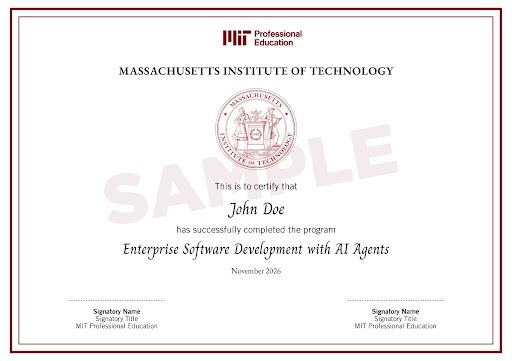
* Image for illustration only. Certificate subject to change.
Who are the faculty for the program?
Learn from renowned MIT faculty who translate cutting-edge research into practical Agentic AI applications.
-
Prof. Tim Kraska
Professor of Electrical Engineering and Computer Science (EECS) at MIT
Member of the Data Systems Group at CSAIL
Former Director of Applied Science at Amazon Web Services (AWS)
Know More
-
Prof. Armando Solar-Lezama
Distinguished Professor of Computing, MIT Schwarzman College of Computing; Associate Director and COO, MIT CSAIL
AI & Program Synthesis Research Leader
Neurosymbolic AI & Programming Systems Expert
Know More
-
Prof. Paul Liang
Assistant Professor, MIT Media Lab and MIT EECS
Forbes 30 Under 30 in Science Honoree
Multimodal AI & Human-AI Interaction Expert
Know More
-
Andrew Wang
Lecturer in the Department of Electrical Engineering and Computer Science (EECS) at MIT
Digital Learning Fellow
Ph.D. in EECS; research on autonomous system scheduling
Know More
-
Ziniu Wu
Co-Founder, G5 Labs
Ph.D., MIT CSAIL (Data Systems Group)
AI-Enhanced Data Infrastructure Researcher
Know More








 LinkedIn Profile
 University Link
Who are the mentors for weekly live sessions?
Learn from seasoned AI industry mentors to apply concepts and build practical skills.
-
David Y Stephenson
Co-Founder, Objective Enterprises
-
Andres Cala
Senior Software Engineer at athenahealth
-
Carlos Damiani Paiva
Frontend Developer, Flowon - Gamification Lab





Note: The faculty and mentors listed above are indicative and subject to change based on availability and scheduling.
Program fee
The course fee is USD 3,400
Invest in your career
-
10-Week Online Journey: Benefit from live online sessions by MIT faculty and build AI-native workflows
-
Structured Learning: Engage with world-renowned MIT faculty across live sessions and hands-on AI projects
-
Dedicated Mentorship: Build practical AI skills in weekly live online sessions with top Industry Mentors
-
Receive a globally recognized certificate from MIT Professional Education


Registration process
Admissions close once the requisite number of participants enroll for the upcoming batch. Apply early to secure your seat.
-
1. Fill application form
Register by completing the online application form.
-
2. Application screening
A panel from Great Learning will assess your application based on academics, work experience, and motivation.
-
3. Join program
After a final review, you will receive an offer for a seat in the upcoming cohort of the program.


Course eligibility
- Minimum score of 60% in each individual module.
Batch start date
-
Online · January 2027
Admission closing soon
Frequently Asked Questions
What will I learn in Enterprise Software Development with AI Agents Program?
The Enterprise Software Development with AI Agents Program by MIT Professional Education equips you to direct AI agents effectively and confidently across the software development lifecycle. Key learning outcomes include:
● Evaluate and select the right models and tools based on how LLMs and agents work, including their capabilities, limitations, and cost trade-offs.
● Direct AI agents to write code using system ontologies and specifications they can reliably interpret and execute.
● Architect new systems and modernize existing codebases with AI agents, applying enterprise-scale design principles and low-risk refactoring strategies.
● Develop AI-enabled software systems using agentic architectures, RAG, and MCP servers.
● Verify that AI-built software works as intended through automated testing, AI evaluations, and formal verification for critical systems.
● Identify and mitigate AI-specific security risks, applying guardrails that keep AI-built software within enterprise security and compliance requirements.
● Accelerate delivery without compromising quality or trust, while keeping AI costs predictable as systems scale.
● Redesign team workflows, roles, and the software development lifecycle for AI-native engineering.
The curriculum progresses from AI fundamentals and agent development to enterprise architecture, testing, organizational strategy, and production deployment. It concludes with a capstone project in which you build and present an end-to-end agentic application for a real-world use case.
Which tools are covered in the program?
The program covers the following tools and technologies:
● Claude Code
● OpenAI
● Docker
● MCP
● G5
*Note: The tools listed are indicative and may change. Claude API access is not included in the program.
How long is the Enterprise Software Development with AI Agents program?
The program duration is 12 weeks.
How does the program teach AI-native software development?
The program teaches AI-native software development by shifting the focus from basic line-by-line coding and generic chatbot prompts to building reliable, enterprise-grade agentic systems. Participants practice:
● Spec-driven development: Translating business requirements into precise specifications and documenting design decisions.
● AI agent development: Building tool-using agents and integrating applications through APIs and MCP servers.
● Testing and security: Evaluating AI-generated code, implementing guardrails, and addressing security and compliance risks.
● Enterprise deployment: Applying modular design, observability, and reliability practices to build production-ready AI applications.
Who teaches the Enterprise Software Development with AI Agents Program?
The program features MIT faculty, including Professor Tim Kraska, Professor Armando Solar-Lezama, Professor Paul Liang, and Andrew Wang. Ziniu Wu is also listed among the program faculty. Industry experts provide live mentorship sessions to support practical learning.
Note: Faculty participation is subject to change.
Which Claude tools do participants explore in the program?
Participants explore three tools in the Claude ecosystem:
● Claude Code: Used for application development, coding workflows, and API integration.
● Claude Chat: Used for model selection and prompt engineering.
● Claude CoWork: Used for agentic workflow design, orchestration, and multistep execution through the Plan → Approve → Execute → Iterate framework.
(Note: The program specifies that Claude API access is not included as part of the enrollment, though participants can explore advanced usage independently.)
What topics are covered in the AI agent software development curriculum?
The curriculum covers Generative AI and large language models, agentic AI fundamentals, requirements and architecture, testing and quality assurance, ontology-driven development, organizational strategy, AI-enabled software systems, security, compliance, and production deployment. It concludes with an end-to-end capstone project.
Does the program include hands-on projects in AI coding agents for software development?
Yes. Participants complete practical exercises and projects involving AI-assisted application development, agent design, testing, and system integration. Sample projects include a meeting-notes action agent, specification-driven feature development, support ticket triage, and an AI-enabled internal wiki connected through an MCP server.
What is the capstone project in the program?
The capstone involves designing, building, evaluating, and securing an end-to-end agentic application for a real-world enterprise problem. Participants choose a project direction relevant to their role or industry, such as an invoice processing agent, IT helpdesk agent, patient intake agent, or insurance claim triage agent, and present their work during the final-week showcase.
Does the program teach AI agent testing, security, and deployment?
Yes. Participants study AI-assisted test generation, evaluation metrics, human-in-the-loop review, prompt-injection risks, data leakage, privacy, and compliance. They also explore observability, monitoring, reliability, fallback strategies, and production deployment to help make AI-enabled applications more dependable.
How does Agentic AI improve enterprise software development?
Agentic AI improves enterprise software development by automating multistep tasks, connecting tools and APIs, and assisting with coding, testing, and workflow execution. With appropriate human oversight and guardrails, AI agents can help streamline development workflows, improve consistency, and support the delivery of reliable software. The MIT Professional Education Enterprise Software Development with AI Agents program explores how to apply these capabilities in practice. Through hands-on projects, participants build tool-using agents, translate business requirements into precise specifications, evaluate AI-generated code, and address security, reliability, and deployment challenges.
How does program synthesis relate to AI-assisted software development?
Program synthesis involves generating software from specifications or defined requirements. In AI-assisted software development, it connects business intent with code generation and verification. The Enterprise Software Development with AI Agents program explores these principles through spec-driven development, structured specifications, and verification of generated implementations. Its faculty includes Professor Armando Solar-Lezama, whose research focuses on program synthesis and neurosymbolic programming.
Who should apply for the program?
The program is designed for professionals looking to adopt AI-native software development practices, including:
● Software Developers, Solution Architects, and Technical Product Managers: Those seeking to move beyond basic AI-assisted coding to agent orchestration and system design.
● Functional Product Leaders: Those looking to translate business requirements into precise, machine-executable specifications and collaborate with engineering teams.
● Business Analysts and Systems Analysts: Those seeking to understand AI-driven software development and build systems that meet enterprise and regulatory requirements.
How do I apply for the program?
You can apply by completing the online application form. A panel from Great Learning reviews applications to assess each applicant's fit for the program. After the final review, selected applicants receive an offer for a seat in an upcoming cohort.
Do I need prior experience with AI agents to join the program?
The program introduces Generative AI, large language models (LLMs), and Agentic AI fundamentals before progressing to advanced applications. Pre-work covers command-line basics and setup of tools such as Python, VS Code, Docker, and Claude Code. Please check the eligibility requirements with the Great Learning Program Advisor.
What is the fee for the program?
Please contact your Program Advisor for the current program fee, applicable taxes, and payment options.
Does the program include access to Claude or other AI tools?
No, the program does not include complimentary access or API credits for Claude. Claude API access is not included as part of the program, though participants may choose to explore advanced usage independently.
How does the Enterprise Software Development with AI Agents program prepare professionals to build reliable enterprise AI applications?
The program prepares professionals to build reliable enterprise AI applications through hands-on learning in AI agent development, specification-driven design, testing, security, and production deployment. Participants build tool-using agents, evaluate AI-generated code, implement guardrails, and apply observability and reliability practices. It culminates in a capstone project focused on designing, building, evaluating, and securing an end-to-end agentic application.
Which AI agent is best for software development?
The best AI agent for software development depends on your programming language, project complexity, development environment, and integration needs. Claude Code can support AI-assisted coding and application development. The right approach depends on whether you need code generation, tool use, workflow orchestration, or end-to-end application development.
How can I effectively use AI coding agents for software development?
Use AI coding agents by first defining clear requirements, breaking work into manageable tasks, and providing precise specifications and relevant project context. Review generated code, run automated tests, evaluate outputs, and apply security checks before deployment. A structured workflow that combines AI generation with human review can help improve code quality, maintainability, and reliability. These practices align with the program's emphasis on specification-driven development, testing, and governance.
What career opportunities can software developers explore after learning AI agent development?
AI agent development skills can be relevant to roles involving AI-enabled software engineering, agentic application development, solution architecture, and AI systems integration. The skills developed through the program, including agent design, API integration, evaluation, security, and deployment, can help professionals contribute to enterprise AI projects. Specific job outcomes are not guaranteed by the program.
How does learning software development with AI agents help experienced developers?
Learning software development with AI agents can help experienced developers move beyond code generation to system design, workflow orchestration, automated testing, and production readiness. This MIT Professional Education program emphasizes these capabilities alongside specification-driven development and organizational strategy, helping participants understand how to integrate AI agents into enterprise software engineering workflows.
Delivered in collaboration with

MIT Professional Education is collaborating with online education provider Great Learning to offer the Enterprise Software Development with AI Agents program. This program leverages MIT's leadership in innovation, science, engineering, and technical disciplines developed over years of research, teaching, and practice. Great Learning collaborates with institutions to manage enrollments (including all payment services and invoicing), technology, and participant support. Accessibility
 Application closes
12th Nov 2026