Build Practical Expertise in AI, ML, GenAI, and Agentic AI
Applied AI and Data Science Program
 Application closes on
8th Oct 2026
Application closes on
8th Oct 2026
 Speak with our expert
+1 617 468 7899
Speak with our expert
+1 617 468 7899




Receive Your Brochure Copy
Get details on syllabus, projects, tools, and more

Applied AI and Data Science Program
Application closes 8th Oct 2026
Why should you join this program?
-

Build End-to-End AI Expertise
Learn through live online sessions by MIT faculty & build practical expertise in Machine Learning, and Agentic AI through 10+ real-world case studies, hands-on projects using AI tools & technologies
-
Built on MIT’s Legacy of Innovation
MIT is ranked #1 in the world, #1 in AI and Data Science, and #2 among U.S. national universities, reflecting its global leadership in research, innovation, and technology education. (2026 Rankings)


LEARNING OUTCOMES
What will you learn to build and apply?
Through a structured learning journey, you will build the capability to:
-
Apply Python and AI coding assistants to build, debug, and evaluate code for real-world data science tasks
-
Use statistical reasoning and ML techniques to analyze data, build predictive models, and evaluate performance
-
Design deep learning models, including CNNs and transfer learning pipelines for advanced prediction tasks
-
Build AI systems for recommendation engines, time-series forecasting, and unsupervised pattern discovery
-
Build single- and multi-agent systems using LangGraph, RAG, and production frameworks for business challenges
-
Evaluate and deploy Agentic AI workflows using key performance metrics
Earn a certificate of completion from MIT Professional Education
-
#1 in World Universities
QS World University Rankings, 2026
-
#1 in AI and Data Science
QS World University Rankings by Subject, 2026
-
#2 in National Universities
U.S. News & World Report Rankings, 2026


KEY PROGRAM HIGHLIGHTS
Why choose this program?
-
Learn Through Live Online Sessions by MIT Faculty
Benefit from live online sessions by MIT Faculty and develop practical expertise across Data Science, Machine Learning, Deep Learning, Generative AI, and Agentic AI.
-
Attend Mentorship Sessions by Industry Experts
Learn from experienced AI and Data Science practitioners who help connect concepts, tools, and frameworks to real-world applications and business challenges.
-
Build End-to-End AI Capability
Progress through a structured curriculum spanning Data Science, Machine Learning, Deep Learning, Generative AI, and Agentic AI to build and evaluate modern AI systems.
-
Apply AI to Real-World Business Problems
Work on case studies, projects, and a capstone project to develop AI solutions for prediction, automation, recommendation systems, and intelligent workflows.
-
Benefit from Personalized Learning Support
Receive guidance from a dedicated program support team from Great Learning to help you stay on track toward program completion.
-
Earn a Recognized MIT Professional Education Credential
Earn a Certificate of Completion and 16 Continuing Education Units (CEUs) from MIT Professional Education upon successful completion of the program.


Skills you will learn
Agentic AI
Prompt Engineering
Retrieval-Augmented Generation (RAG)
Multi-Agent Systems
LLM Orchestration
Prompt Optimization
AI-Assisted Coding
LLM Evaluation
AI Workflow Design
Generative AI Applications
Data Science
Generative AI
Machine Learning
Data Analysis
Deep Learning
Recommendation Systems
Ethical and Responsible AI
Agentic AI
Prompt Engineering
Retrieval-Augmented Generation (RAG)
Multi-Agent Systems
LLM Orchestration
Prompt Optimization
AI-Assisted Coding
LLM Evaluation
AI Workflow Design
Generative AI Applications
Data Science
Generative AI
Machine Learning
Data Analysis
Deep Learning
Recommendation Systems
Ethical and Responsible AI
view more
- Overview
- Learning Journey
- Curriculum
- Projects
- Tools
- Certificate
- Faculty
- Mentors
- Reviews
- Career Support
- Fees
- FAQ
Who is the program for?
Working professionals looking to implement AI for business impact or transition into AI and Data Science roles
-
Senior Technology Professionals
Ready to move beyond experimenting with AI toward designing and deploying production-grade AI systems and multi-agent workflows.
-
Early-Career Professionals
Experimenting with GenAI tools who want to build a rigorous technical foundation in Data Science, Machine Learning, and Agentic AI systems.
-
Career Transitioners
Seeking expertise in Python, Machine Learning, Agentic AI systems, and modern AI frameworks and tools such as LangChain, LangGraph, and Claude.
How's the learning experience of the program?
Build strategic judgment and human intuition with our unique structured learning approach.
-
Learn from Experts
Learn from MIT faculty and industry experts to build practical expertise in AI and Data Science
-
Learn By Doing
Work on business problems & case studies using tools & build an e-portfolio of AI projects
-
Earn a University Credential
Earn a Certificate of Completion and 16 CEUs from MIT Professional Education
-
Get Support Throughout the Learning Journey
A program support team will help you navigate key milestones & complete the program




What will you learn in the program?
Designed by MIT faculty, this program offers learners a complete architectural journey from classical predictive modeling to multi-agent system orchestration, equipping leaders with the critical technical intuition and strategic judgment necessary to build reliable, data-grounded solutions.
-
Masterclass
On Anthropic
-
Live Online
Sessions by MIT Faculty
-
10+
Emerging Tools
Pre-Work: Python, Data Science, and AI Foundations
Establish the coding and conceptual foundations needed for the program.
Concepts Covered
Week 1: AI-Assisted Python Programming
Use AI coding tools to accelerate Python development while evaluating generated code critically.
Concepts Covered
Week 2: AI-Assisted Statistical Analysis and Data Preparation
Apply inferential statistics and AI tools to draw defensible conclusions from sample data.
Concepts Covered
Project
Week 3: Data Analysis and Visualization (Live)
Apply dimensionality reduction and clustering techniques to uncover patterns in high-dimensional data.
Concepts Covered
Week 4: Machine Learning (Live)
Build and rigorously evaluate supervised Machine Learning models for regression and classification.
Concepts Covered
Week 5: Refresher Break
A dedicated week of refresher sessions to help you catch up on coursework and consolidate your learning.
Week 6: Practical Data Science (Live)
Apply tree-based models and time series methods to solve classification, regression, and forecasting problems.
Concepts Covered
Week 7: Deep Learning (Live)
Build and apply neural network architectures, including CNNs and transfer learning pipelines.
Concepts Covered
Week 8: Recommendation Systems (Live)
Build production-ready recommendation systems that handle sparse and time-varying data at scale.
Concepts Covered
Week 9: Refresher Break
A dedicated week of refresher sessions to help you catch up on coursework and consolidate your learning.
Week 10: Elective Project
Develop an end-to-end solution by selecting a problem statement from a chosen domain and applying appropriate data science and AI techniques.
Concepts Covered
Week 11: Generative AI and Agentic AI Foundations
Understand the architecture of autonomous AI agents and build functional single-agent systems.
Concepts Covered
Week 12: Building & Evaluating Agentic AI Workflows
Design multi-agent systems and evaluate their performance using production-grade metrics.
Concepts Covered
Weeks 13–15: Capstone Project
Design and deliver an end-to-end AI solution for a selected problem statement, integrating concepts and techniques from across the program.
Concepts Covered
Self-Paced Module: Ethical and Responsible AI
Understand and apply ethical principles across the AI lifecycle to design fair, transparent, and responsible AI systems.
Concepts Covered
Self-Paced Module | Claude-Based AI Workflows
This module is designed to build practical capability in applying Artificial Intelligence and Data Science using the Claude ecosystem in real-world contexts. Learners build the ability to design, execute, and evaluate AI-driven workflows for real-world applications, supported by ~5 hours of structured learning.
Concepts Covered
Masterclass on Anthropic
This masterclass covers the Anthropic AI landscape, exploring Claude models, Constitutional AI, and key safety and alignment principles. Learners will apply effective prompting, use the Claude API for tasks and integrations, generate structured outputs, build simple applications, critically compare Claude with other AI models, and evaluate ethical considerations for deploying AI systems.
Sample Case Studies
Apply your learning through real-world case studies guided by global industry experts. Please note: All case studies and projects outlined are indicative and subject to change.
Sales Performance Analysis for a Regional Retailer
A/B Test Analysis for a Subscription Fitness App
Customer Segmentation for a D2C Beauty Brand
Credit Default Risk Prediction for a Digital Lender
Demand Forecasting and SKU Prioritization for a Quick-Commerce Platform
Defect Detection on a Manufacturing Production Line
Personalized Product Recommendations for an E-commerce Marketplace
Employee HR Policy Single-Agent Assistant
Banking Customer Service Multi-Agent Copilot
Elective Project
Build an end-to-end solution by selecting a problem from retail analytics, HR analytics, forecasting, computer vision, or recommendation systems. Work on real-world datasets to apply exploratory data analysis, Machine Learning, deep learning, and recommendation system techniques to solve a chosen business problem. Skills you will learn: EDA, Machine Learning, Deep Learning, Recommendation Systems, Predictive Modeling
Capstone Project
Design and deliver an end-to-end AI solution on a problem statement of your choice, drawing from any topic covered in the program. Work on real-world challenges across data science, Machine Learning, deep learning, recommendation systems, and generative and Agentic AI workflows to build scalable, production-ready solutions. Skills you will learn: End-to-End AI Systems, Data Science, Machine Learning, Deep Learning, Generative AI, Agentic AI
Note: The curriculum listed above is indicative and subject to updates as technology evolves.
What capstone project will you work on?
Work on a real-world capstone project in your choice of industry and function
-
Work with
Emerging tools
-
Access
OpenAI API keys, Codex

Supply Chain & Logistics / Manufacturing
Supply Chain Disruption Risk Analysis
Description
Analyze supplier, warehouse, and transportation performance data using EDA, PCA, and clustering techniques to identify high-risk suppliers and distribution routes, enabling proactive risk mitigation and more resilient supply chain operations.
Skills you will learn
- Unsupervised Learning & Clustering

Media & Entertainment / OTT
Subscription Churn Analysis for a Video Streaming Platform
Description
Build a classification model to predict subscriber churn using viewing behavior, engagement patterns, and account activity, enabling targeted retention campaigns and reducing revenue loss from cancellations.
Skills you will learn
- Supervised ML: Classification

Healthcare
Patient Segmentation for a Hospital Network
Description
Apply PCA and clustering techniques to group patients based on visit history, treatment patterns, and healthcare needs, helping hospitals deliver more personalized care and improve patient engagement strategies.
Skills you will learn
- Unsupervised Learning & Customer Segmentation

Insurance / InsurTech
Insurance Claim Amount Prediction
Description
Develop a regression model to estimate insurance claim amounts using policyholder, policy, and claim information, helping insurers improve reserve planning, streamline claims processing, and manage risk more effectively.
Skills you will learn
- Supervised ML: Regression

Note: The projects listed above are indicative and subject to updates to the curriculum.
Which tools will you learn and apply?
Learn tools like OpenAI, Python, VS Code, Claude & more to build, evaluate, and deploy intelligent AI systems.
-
Python
-
Google Colab
-
VS Code (Visual Studio Code)
-
OpenAI
-
Gemini
-
Claude
-
LangChain
-
LangGraph








Note: The tools listed above are indicative and subject to updates as technology evolves.
Earn a Certificate of Completion from MIT Professional Education
Stand out in a competitive market with a Certificate of Completion in Applied AI & Data Science from MIT Professional Education & earn 16 CEUs that formally recognize the expertise developed through rigorous assessments.
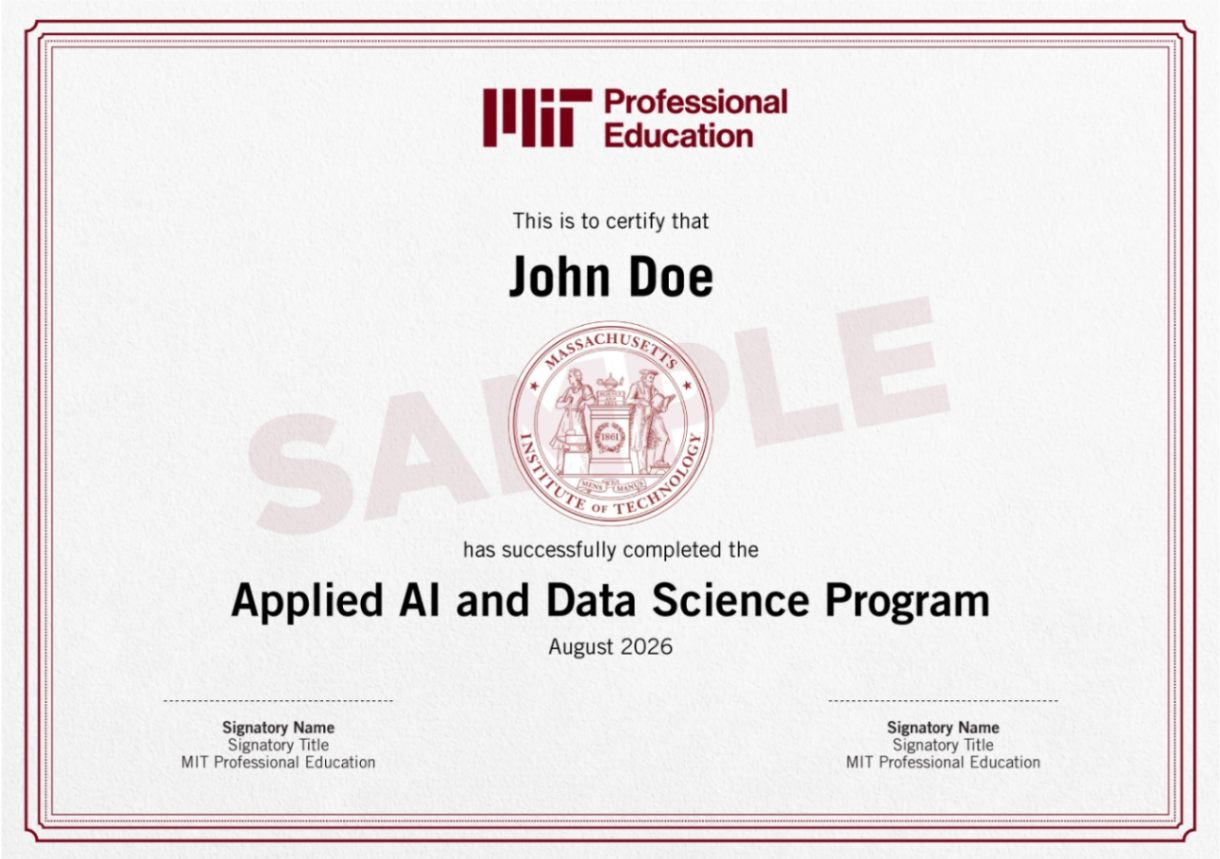
* Image for illustration only. Certificate subject to change.
Who are the faculty for the program?
Learn from renowned MIT faculty and build technical intuition to make credible, strategic decisions.
-
Caroline Uhler
Professor, EECS and IDSS
Expert in computational biology, statistics, and systems.
Award-winning scholar relentlessly driving transformative data insights.
Know More -
John N. Tsitsiklis
Clarence J. Lebel Professor, Dept. of Electrical Engineering & Computer Science (EECS) at MIT
Leader in optimization, control, and learning.
Renowned scholar with multiple prestigious accolades.
Know More -
Munther Dahleh
William A. Coolidge Professor, EECS and IDSS; Founding Director, IDSS
Trailblazer in robust control and computational design.
Director propelling interdisciplinary research and innovation.
Know More -
Stefanie Jegelka
Associate Professor, EECS and IDSS
Expert in algorithms and optimization for AI.
Pioneer advancing theoretical machine learning foundations.
Know More -
Devavrat Shah
Andrew (1956) and Erna Viterbi Professor, EECS and IDSS
Renowned expert in large-scale network inference.
Award-winning innovator in data-driven decisions.
Know More


 LinkedIn Profile
 University Link
Who are the mentors for weekly live sessions?
Learn from seasoned AI industry mentors to apply concepts and build practical skills.
-
Omar Attia
Senior Machine Learning Engineer Apple (US)
-
Matt Nickens
Senior Manager, Data Science CarMax
-
Nirmal Budhathoki
Senior Data Scientist Microsoft
-
Mohit Khakaria
Senior Machine Learning Engineer Ford Motor Company
-
Udit Mehrotra
Senior Data Scientist Google
-
Amish Suchak
Data Science Team Lead XSOLIS
-
Nirupam Sharma
Data Science Vice President Big Village
-
Deepa Krishnamurthy
Director, AI Solutions Engineering Koru
-
Marco De Virgilis
Actuarial Data Scientist Manager Arch Insurance Group Inc.
-
Cristiano Santos De Aguiar
Biomedical Machine Learning Engineer, Oncoustics
-
Saber Fallahpour
Principal Data Scientist, Siemens
-
Asim Sultan
Senior Machine Learning Engineer RiskHorizon AI
-
Vibhor Kaushik
Senior Machine Learning Scientist, Amazon
-
Vaibhav Verdhan
Senior Director Global, AstraZeneca











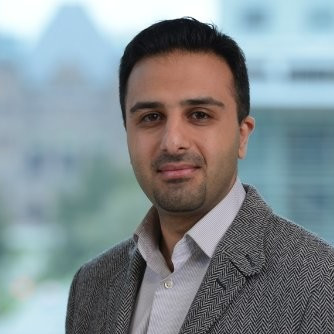
.jpeg "Asim Sultan - Mentor")



Note: The mentors listed above are indicative and subject to change based on availability and scheduling.
Watch inspiring success stories
Get authentic feedback from our learners sharing their experiences and insights with the course
-
Watch story
"MIT faculty are some of the best teachers I have ever had"
MIT faculty explain everything from the very basic theory of every machine learning algorithm to the toughest concepts. Mentors let you see the practical side of things too. This is the course every student who wants to get into data science should take.
Mauricio De Garay
Student ,
-
Watch story
"From Day 1 was able to solve meaningful, real world, tangible problems"
I had a great experience with world-class instructors and live classes led by industry experts who clearly explained each concept. I highly recommend this program to anyone considering a career shift.
Brooks Christensen
DevOps Engineer , Nielsen
-
Watch story
"The course was seamless and very engaging"
I enrolled to refresh my technical knowledge, and the projects were highly relevant to real-life scenarios. The mentor was an exceptional coder who explained concepts clearly, and the neural networks sessions were both engaging and fun with great examples.
Gabriela Alessio Robles
Senior Analytics Engineer , Netflix
What support will you receive to advance in your career?
-
Get dedicated career support
Access personalized guidance to strengthen your professional brand.
-
1-on-1 career sessions
Interact with industry professionals to gain actionable career insights.
-
Resume & LinkedIn profile review
Showcase your strengths with a polished, market-ready profile
-
Build your project portfolio
Build an industry-ready portfolio to showcase your skills




What are the fees for the program?
The course fee is USD 3,900
Advance your career
-
15-Week Online Journey: Benefit from live online sessions by MIT faculty & build end-to-end AI expertise
-
Structured Learning: Dedicate 12-18 hours weekly to faculty videos, mentor sessions, and hands-on AI projects
-
Dedicated Mentorship: Build practical AI skills in weekly live online sessions with top Industry Mentors
-
Earn a globally recognized certificate from MIT PE and earn 16 CEUs to validate your AI expertise


Registration process
Our registrations close once the requisite number of participants enroll for the upcoming batch. Apply early to secure your seat.
-
1. Fill application form
Register by completing the online application form.
-
2. Application screening
A panel from Great Learning will assess your application based on academics, work experience, and motivation.
-
3. Join program
After a final review, you will receive an offer for a seat in the upcoming cohort of the program.


Eligibility
- Exposure to computer programming and a high school-level knowledge of Statistics and Mathematics
Batch start date
-
Online · 21st Nov 2026
Admission closing soon
Frequently Asked Questions
What is MIT Professional Education's (MIT PE) Applied AI and Data Science Program?
MIT Professional Education's Applied AI and Data Science Program is a 15-week online program that builds technical capability in Data Science, Machine Learning, Generative AI, and Agentic AI. Delivered through 15 live online sessions by MIT faculty, the program also includes recorded lectures, expert mentorship, 10+ case studies, hands-on projects, and a capstone project. Learners who complete the program receive a Certificate of Completion from MIT Professional Education and 16 Continuing Education Units (CEUs).
How long is MIT Professional Education's Applied AI and Data Science Program?
The program runs for 15 weeks and is delivered entirely online. It includes 15 live online sessions by MIT faculty, mentor-led sessions, self-paced modules, a graded elective project, and a final capstone project spanning weeks 13 through 15.
How many hours per week does this program require?
The 15-week program requires an average of 12–18 hours per week. This includes recorded lectures and live online sessions with MIT faculty, mentored learning sessions, self-study, and project work. The program includes two refresher break weeks (weeks five and nine) to allow learners to consolidate content and complete pending work.
What skills and capabilities will I develop through this program?
After completing the program, you will be able to:
● Apply Python and AI coding assistants to build, debug, and evaluate code for real-world Data Science tasks.
● Design and train deep learning models, including CNNs and transfer learning pipelines, for pattern recognition and advanced prediction tasks.
● Construct single-agent and multi-agent AI systems using LangGraph, RAG, and production frameworks to solve autonomous business problems.
● Use statistical reasoning and Machine Learning techniques to analyze data, build predictive models, and rigorously evaluate performance.
● Build end-to-end AI systems for recommendation engines, time-series forecasting, and unsupervised pattern discovery.
● Evaluate and build Agentic AI workflows using key performance metrics such as tool accuracy and adaptive reasoning quality.
What do I learn each week in the Applied AI and Data Science Program?
The 15-week curriculum is structured as follows:
● Pre-work: Python, Data Science, and AI Foundations (Python fundamentals, data science foundations, probability, and descriptive statistics)
● Week 1: AI-Assisted Python Programming (using tools like VSCode, Codex, and GPT-5)
● Week 2: AI-Assisted Statistical Analysis and Data Preparation (inferential statistics, hypothesis testing, and AI-assisted data preparation)
● Week 3: Data Analysis and Visualization (dimensionality reduction, network representation, and clustering)
● Week 4: Machine Learning (regression, classification, and model evaluation)
● Week 5: Refresher Break (catch up on coursework and consolidate learning)
● Week 6: Practical Data Science (decision trees, ensemble learning, and time series analysis)
● Week 7: Deep Learning (neural network foundations, CNNs, and transfer learning)
● Week 8: Recommendation Systems (collaborative filtering, matrix estimation, and neural approaches)
● Week 9: Refresher Break (catch up on coursework and consolidate learning)
● Week 10: Elective Project (select a problem statement from a chosen domain and apply AI techniques)
● Week 11: Generative AI and Agentic AI Foundations (autonomous agents, memory, planning, and tool use)
● Week 12: Building and Evaluating Agentic AI Workflows (multi-agent systems, adaptive RAG, and production metrics)
● Weeks 13–15: Capstone Project (design and deliver an end-to-end AI solution integrating concepts across the program)
Additionally, the program features:
● Self-paced Modules: Ethical and Responsible AI; Claude-Based AI Workflows (supported by ~5 hours of structured learning).
● Masterclass: Anthropic session covering Claude model capabilities, Constitutional AI, safety, API usage, and application development.
What tools and technologies does the program cover?
The program covers Python, Google Colab, Visual Studio Code, OpenAI GPT-5, Gemini, Claude, LangChain, LangGraph, and Codex. Learners also receive access to OpenAI API keys and Codex for AI-assisted coding, provided by Great Learning. The curriculum applies these tools across Data Science, Machine Learning, Generative AI, and Agentic AI use cases.
Does the program cover Generative AI and Agentic AI?
Yes. The program covers Generative AI and Agentic AI foundations, including the architecture of autonomous AI agents, single-agent workflow design, and applying agents to solve business problems. It also covers building and evaluating Agentic AI workflows, including multi-agent system design, Retrieval-Augmented Generation (RAG), dynamic task routing, and evaluation metrics such as tool accuracy and BERTScore. There is also a self-paced module on Claude-based AI workflows.
What Agentic AI skills does the program build?
The program builds Agentic AI skills in designing and constructing single-agent and multi-agent AI systems using LangGraph, RAG, and production frameworks. Learners work on designing task-oriented agent workflows, handling uncertainty and errors in agent systems, applying adaptive RAG in multi-agent generative AI contexts, and evaluating agent performance using metrics such as tool accuracy, ROUGE, BERTScore, and LLM-as-a-Judge. A self-paced module also covers Agentic workflow design and orchestration using Claude.
What kinds of projects and case studies are included in the program?
The program includes 3 graded projects (1 data analysis project due in week 2, 1 elective project, and 1 capstone project), and 10+ case studies spanning industries including retail, finance, SaaS, e-commerce, manufacturing, and HR.
Sample case studies include an employee HR policy single-agent assistant, a credit default risk predictor, and a banking customer service multi-agent copilot. The capstone project runs across weeks 13–15 and requires learners to design and deliver an end-to-end AI solution integrating concepts and techniques from across the entire program.
Are there quizzes in the program, and how are they graded?
Yes. The program includes 9 graded quizzes focused on key concepts in Machine Learning, Deep Learning, Generative AI, and Agentic AI. These quizzes are designed to build your practical intuition and ensure you are mastering the tools and techniques as you progress. To successfully complete the program and earn your certificate, you must score at least 60% in each course.
What is the capstone project in the Applied AI and Data Science Program?
The capstone project spans weeks 13–15 and requires learners to design and deliver an end-to-end AI solution for a chosen problem statement. It integrates techniques from across the program, including Data Analysis, Machine Learning, Deep Learning, Recommendation Systems, and Generative and Agentic AI workflows. Learners design and deliver an end-to-end AI solution for a selected problem statement, integrating concepts and techniques from across the program.
Who teaches the MIT PE Applied AI and Data Science Program?
The 15 live online sessions are led by MIT faculty. Program faculty include:
● Devavrat Shah - The Andrew (1956) and Erna Viterbi Professor in the Department of Electrical Engineering and Computer Science at MIT.
● Munther Dahleh, William A. Coolidge Professor and the founding director of the Institute for Data, Systems, and Society (IDSS).
● Caroline Uhler - A faculty member at MIT with joint appointments in Electrical Engineering and Computer Science (EECS) and the Institute for Data, Systems, and Society (IDSS).
● John Tsitsiklis, Clarence J. Lebel Professor in the Department of Electrical Engineering and Computer Science at MIT is affiliated with the Laboratory for Information and Decision Systems.
● Stefanie Jegelka is an Associate Professor in the Department of Electrical Engineering and Computer Science at MIT.
Note: Program faculty names above are indicative and subject to change
What role do program mentors play in the Applied AI and Data Science Program?
Program mentors are Data Science and Machine Learning professionals from companies including Apple, Amazon, Microsoft, BlackRock, Google, Ford, AstraZeneca, and Siemens Healthineers. They deliver 8+ hours of recorded video lectures and lead live mentored learning sessions. Mentors guide learners through industry case studies and projects, providing practical context for applying concepts to real-world scenarios. Note: the mentor list is indicative and subject to change.
Who is the Applied AI and Data Science Program designed for?
The program is designed for three groups:
● Senior technology professionals and architects who want to move from experimenting with AI toward building production-grade AI systems;
● Early-career professionals experimenting with Generative AI tools who want to build a rigorous technical foundation in Data Science, Machine Learning, and Agentic AI; and
● Professionals transitioning into AI and Data Science roles who want hands-on skills in Python, LangGraph, LangChain, and Claude.
Do I need coding experience before registering for this program?
Yes. The program requires basic exposure to computer programming and a high school-level knowledge of Statistics and Mathematics.
What level of math or statistics is required for this program?
The program requires a high school-level knowledge of statistics and mathematics. You do not need advanced calculus or graduate-level statistics. To ensure you are fully prepared, foundational concepts like probability and descriptive statistics are covered during the Pre-work phase.
Once the official weeks begin, Week 1 is dedicated entirely to AI-Assisted Python Programming, while Week 2 introduces inferential statistics and hypothesis testing. This structured timeline allows you to comfortably build up your skills starting directly from a basic high school foundation.
Who should not register for this program?
The program is not the right fit if you are looking for a research-focused or purely academic study of AI, if you need a graduate-level credential or degree, or if you have no interest in working with data and code at a technical level. The program requires at least basic exposure to computer programming and high school-level knowledge of statistics and mathematics.
Learners who are not comfortable with hands-on technical work or who need more than 15 weeks to build foundational skills may find the pace challenging.
Can I do this program while working full-time?
Yes. The program is structured for professionals with full-time roles. Learners should commit an average of 12–18 hours per week. The program includes 15 live online sessions, mentored learning sessions, self-study, and related activities. Recorded lectures are available for review. The 15-week structure also includes two dedicated refresher break weeks to allow learners to consolidate learning and catch up on coursework.
What certificate will I receive after completing the Applied AI and Data Science Program?
Upon successful completion, you receive a Certificate of Completion from MIT Professional Education. The certificate names the Applied AI and Data Science Program and is issued by MIT Professional Education. To complete the program, learners must score at least 60% in each course, including the elective project and capstone project.
Does the Applied AI and Data Science Program offer Continuing Education Units?
Yes. Learners who complete the program earn 16 Continuing Education Units (CEUs). CEUs are a nationally recognized measure of continuing education and professional development. They are separate from the Certificate of Completion from MIT Professional Education.
What support is available if I fall behind or struggle during the program?
Each learner has access to a program support team from Great Learning, which serves as the primary point of contact throughout the program. The program support team monitors progress, provides guidance, and connects learners with appropriate support from the program ecosystem. The program also includes two dedicated refresher break weeks (weeks five and nine) built into the schedule for catching up on coursework. The 92% program completion rate reflects the structured support available.
What is the program fee for the Applied AI and Data Science Program?
The program fee is USD 3,900.
What is the registration process for the Applied AI and Data Science Program?
The program offers a simplified application process to follow:
First, complete the online application form.
Second, a panel from Great Learning reviews your application based on academic background, work experience, and motivation.
Third, after a final review, you receive an offer for a seat in an upcoming cohort.
For questions about registration, contact Great Learning at aaidsp.mit@mygreatlearning.com or +1 617 468 7899.
What is Applied AI?
Applied AI refers to using artificial intelligence tools and systems to solve real-world business problems, rather than developing AI algorithms from scratch. It focuses on selecting, building, and evaluating AI models in practical contexts: designing workflows, interpreting outputs, building agents, and making data-driven decisions with AI. The Applied AI and Data Science Program reflects this by combining data fundamentals and Machine Learning with Generative AI, Agentic AI, and multi-agent workflow skills.
How is Applied AI different from traditional AI?
Traditional AI development focuses on building algorithms, training models from scratch, and conducting research. Applied AI focuses on implementing and building AI systems to address specific business outcomes. In practice, this means working with existing large language models, building multi-agent workflows, applying Generative AI tools, and evaluating AI outputs for reliability and business impact, which is what the Applied AI and Data Science Program trains you to do.
What is Great Learning's role in the Applied AI and Data Science Program?
MIT Professional Education's Applied AI and Data Science Program is delivered in collaboration with Great Learning. The curriculum is developed and taught by MIT faculty. Great Learning handles program delivery, registration, learner support, and mentorship. Your program support team is provided by Great Learning throughout the program. Great Learning also provides learners with access to OpenAI API keys and Codex for AI-assisted coding.
Delivered in Collaboration with:

MIT Professional Education is collaborating with online education provider Great Learning to offer the Applied AI and Data Science Program. This program leverages MIT's leadership in innovation, science, engineering, and technical disciplines developed over years of research, teaching, and practice. Great Learning collaborates with institutions to manage enrollments (including all payment services and invoicing), technology, and participant support. Accessibility
 Application Closes
8th Oct 2026
Application Closes
8th Oct 2026